
Sliding Drawer Structure
Drawer Structure
Structure
Printing & Finish
Application
Custom Drawer Rigid Box
Premium Sliding Rigid Box with Custom Outer Sleeve, Inner Tray & Luxury Finishing
Custom Drawer Rigid Boxes combine a rigid outer sleeve with a sliding inner tray, creating a structured presentation box for premium products, gift sets and branded retail packaging. The box can be customized with printed wrapping paper, specialty finishes and different drawer-opening options.
The inner tray slides into a rigid outer sleeve and can be designed with a ribbon pull, finger notch or other opening detail depending on the product and presentation requirements.
Custom dimensions, drawer structure, wrapping paper, inserts, printing, ribbon pulls and premium finishing options are available.
Drawer Rigid Boxes Developed Around Your Product
A drawer rigid box combines an outer sleeve with a sliding rigid tray. The final construction should be developed according to the product, internal fit, sliding clearance, opening method, insert and presentation requirements.
Product Fit
Internal dimensions and clearances should be developed around the actual product, inner packaging and intended arrangement.
Sliding Fit
The relationship between the outer sleeve and inner tray should be reviewed according to the board, wrapping paper, dimensions and intended sliding behaviour.
Opening Method
Ribbon pulls, thumb notches or other opening details should be reviewed according to the tray direction and intended user experience.
Internal Presentation
Paperboard or corrugated inserts may be developed to position, separate or present products inside the sliding tray.
The outer sleeve, sliding tray, opening feature and insert should be reviewed as one packaging system rather than as separate components.
How to Specify a Drawer Rigid Box
The final drawer box dimensions and construction should be reviewed according to the product, internal arrangement, sleeve and tray relationship, opening method and packing conditions.
Product Dimensions and Weight
Provide accurate product dimensions, weight, shape and any inner packaging that will remain inside the final drawer box.
Internal Clearance and Arrangement
Confirm the product orientation, number of items, required clearances and whether an insert or divider is required.
Sleeve and Tray Relationship
Review the outer sleeve, inner tray, board construction and required dimensional relationship for the intended sliding fit.
Opening and Packing Method
Consider the tray direction, ribbon or notch position, product loading, storage, stacking, shipping cartons and handling conditions.
Final dimensions should be confirmed using the actual product, outer sleeve, inner tray, insert, wrapping material and production tolerances.
Customize Your Drawer Rigid Box
Develop the sleeve, tray, wrapping paper, printing, finishes, opening details and internal arrangement around your product, box structure and presentation requirements.
Custom Dimensions
Develop the sleeve, tray and internal dimensions around the product, insert, required clearances and final rigid-board construction.
Wrapping Paper Selection
Review coated, kraft or specialty paper directions according to the required appearance, printing and wrapping structure.
Printing and Branding
Brand colours, graphics and artwork placement may be developed according to the sleeve, tray, wrapping paper and production method.
Surface Finishes
Selected foil, embossing, debossing, varnish or lamination directions may be reviewed according to the paper and artwork.
Opening Details
Ribbon pulls, thumb notches and other access features can be reviewed according to the tray direction and intended user experience.
Custom Inserts and Dividers
Paperboard or corrugated inserts can be developed to position, separate or present products inside the sliding tray.
Available paper, printing, finishing, opening and insert options depend on the product, box structure, quantity, artwork and final production assessment.
Sliding behaviour depends on the complete combination of sleeve and tray dimensions, board construction, wrapping material, assembly tolerances and intended use.
Rigid Board, Wrapping Paper and Insert Options
Review rigid-board, wrapping-paper and insert directions according to the product, drawer-box structure, visual requirements and intended packing conditions.
Rigid Greyboard
A rigid-board direction used to form the outer sleeve and sliding tray, subject to box size and structural requirements.
Coated Wrapping Paper
A coated paper direction that may support selected printing, colour and finishing requirements.
Kraft Wrapping Paper
A kraft paper direction for selected natural visual and tactile requirements, subject to printing and wrapping assessment.
Specialty Paper Direction
Selected textured, coloured or decorative papers may be reviewed according to the box geometry, artwork and production method.
Paperboard Insert
A die-cut paperboard insert developed for product positioning, separation or internal presentation.
Corrugated Insert
A corrugated insert direction that may be reviewed where additional spacing, separation or structural support is required.
Board, wrapping paper and insert specifications should be confirmed according to the product dimensions, weight, box size, presentation, packing method and distribution conditions.
Product retention and protective performance depend on the complete combination of box structure, board, insert geometry, clearances, product weight and handling conditions.
Custom Size
Straight Tuck End Cartons can be manufactured around your exact product dimensions. Provide the finished inside dimensions as Length × Width × Height, together with your quantity, material and printing requirements.
Length × Width × Height
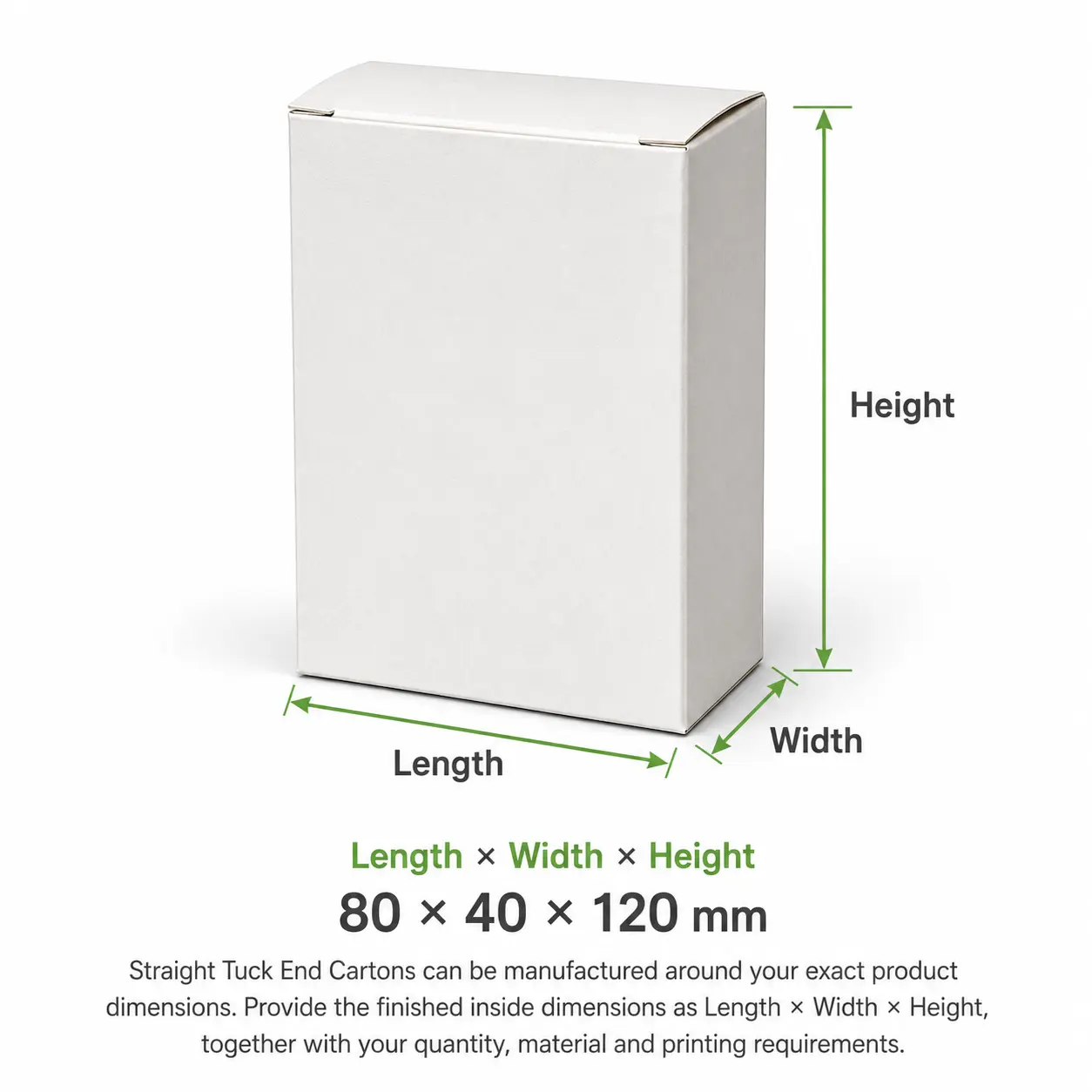
Enter your carton dimensions in the order Length × Width × Height. The L / W / H positions are shown directly on the dimension image above.
Configure Your Carton
Enter your basic requirements below to request a custom Straight Tuck End Carton quotation.
Artwork, Dieline and Sample Review
Review the product information, drawer-box structure, dieline, artwork placement and sample type before the final production specification is confirmed.
-
01
Product and Box Information
Provide the product dimensions, weight, arrangement, preferred tray direction and any available physical samples or reference packaging.
-
02
Structural and Artwork Review
The sleeve, tray, insert arrangement, dieline and visible artwork areas should be reviewed before sample production.
-
03
Pre-Production Sample
A structural prototype or printed sample may be requested to review fit, sliding behaviour, opening details, insert position and artwork placement.
Sample review should use the actual product whenever product fit, insert clearance or sliding behaviour is critical.
Colour, paper, board, printing and surface-finish results may vary according to the sample type and production method.
Questions About Custom Drawer Rigid Boxes
Review common questions about drawer-box structures, custom sizes, sliding fit, opening details, inserts, printing and pre-production samples.
What is a drawer rigid box?
A drawer rigid box combines an outer rigid sleeve, a sliding rigid tray and selected opening or internal components.
The sleeve, tray, opening feature and insert should be developed together according to the product, required clearances, tray direction and intended presentation.
Can drawer rigid boxes be made in custom sizes?
Yes. The sleeve, tray and internal dimensions can be developed around the actual product, inner packaging, number of items, arrangement, insert requirements and required clearances.
Accurate product dimensions, weight and orientation should be provided before the final structure and dieline are confirmed. A physical product sample may be required where fit is critical.
How is the sliding fit confirmed?
Sliding fit should be reviewed according to the sleeve dimensions, tray dimensions, board construction, wrapping paper, assembly tolerances and intended use.
A structural prototype may be used to review the relationship between the sleeve and tray. Fixed sliding resistance, opening cycles or service life should not be assumed without a confirmed specification and corresponding evaluation.
Can ribbon pulls or thumb notches be added?
Ribbon pulls, thumb notches and other access details can be reviewed according to the tray direction, sleeve structure, product arrangement and intended opening experience.
A tray-opening ribbon should be distinguished from a product extraction ribbon or decorative ribbon because each feature has a different position, attachment method and function.
Can custom inserts be developed?
Paperboard or corrugated inserts may be developed to position, separate or present products inside the sliding tray.
The insert structure depends on the product dimensions, shape, weight distribution, number of items, arrangement, clearances and available internal tray dimensions.
Can printing and decorative finishes be included?
Printing and selected decorative finishes may be included depending on the wrapping paper, box structure, artwork, visible surface and production method.
Foil, embossing, debossing, varnish or lamination directions should be reviewed according to the paper, graphic detail, folds, wrapped edges and final drawer-box construction.
Can I request a sample before production?
A structural prototype or printed sample may be requested before mass production.
The sample may be used to review product fit, sleeve and tray clearances, sliding behaviour, opening details, insert position and artwork placement. Colour, paper and surface-finish comparison depends on the sample materials and production method.
Final sleeve dimensions, tray dimensions, opening details and insert arrangement should be confirmed together with the actual product, wrapping material, assembly method and production tolerances.
Create Your Custom Drawer Rigid Boxes
Tell us your box size, quantity and printing requirements. Our packaging team will prepare a custom quotation and dieline for your project.
Send Your Requirements
Include your preferred carton size, order quantity, material, printing and finishing requirements for a more accurate quotation.